Description
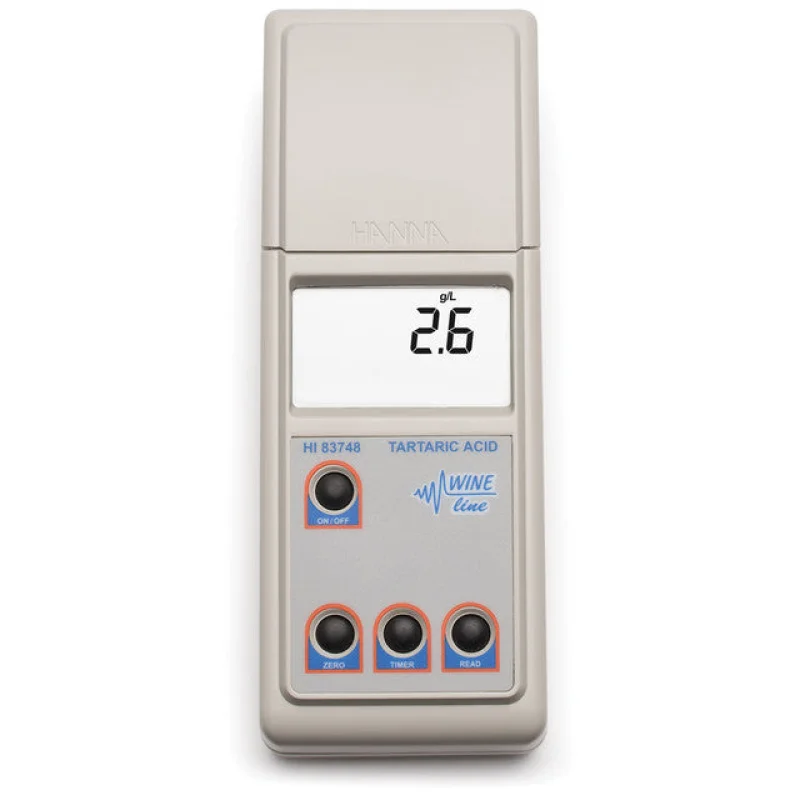
The HI83748 photometer is engineered for the accurate determination of tartaric acid in wine. Hanna’s photometers are equipped with an advanced optical system that ensures consistently precise readings. This system combines a high-quality tungsten lamp, a narrow band interference filter, and a sensitive silicon photodetector. The exclusive cuvette locking feature guarantees that the vial is inserted in the exact same position for every measurement, maintaining a uniform path length and ensuring reliable results.
Features at-a-glance
Built-in timer – Displays the time remaining before a measurement is taken, ensuring all readings are captured at the correct reaction intervals.
Zero key – A simple press of a button automatically accounts for the natural color and any imperfections in the wine sample prior to adding the reagents.
Auto shut-off – The meter automatically turns off after 15 minutes of inactivity in measurement mode, which helps to conserve battery life.
Battery status indicator – Provides a clear indication of the remaining battery life.
Error messages – Alerts users to problems such as an inverted sample, no light, or out-of-range readings.
Units of measure – Displays the appropriate unit of measure alongside the reading.
Tartaric acid is the most prevalent acid in wine, typically constituting up to 60% of its total acidity, with concentrations normally ranging from 1.5 to 4.0 g/L. It is important not to confuse tartaric acid concentration with total or titratable acidity, as other acids like malic, citric, and various volatile acids also contribute significantly. The HI83748 uses a two-reagent method to determine tartaric acid concentrations up to 5.0 g/L. When the reagents are added to a tartaric acid-containing sample, an orange-red hue develops, with the color intensity directly proportional to the concentration. This color change is analyzed colorimetrically using the Beer-Lambert Law, where a 525 nm (green) interference filter allows only green light to be detected. As the samples color increases, its light absorbance at this specific wavelength also increases, leading to a decrease in transmittance.
Tartaric acid and tartrates play a critical role in wine stability, existing in various forms such as tartaric acid ($H_2T$), potassium bitartrate (KHT), and calcium tartrate (CaT), with their ratios largely dependent on the wine’s pH. The formation of crystalline deposits, known as tartrate casse, is a natural phenomenon of wine aging that can be undesirable to consumers. Winemakers can reduce the potential for this precipitation by adjusting the wines pH. The solubility of potassium bitartrate, for instance, decreases in the presence of alcohol and at low temperatures. During alcoholic fermentation, its decreasing solubility can lead to supersaturation and precipitation. This instability can be resolved through cold stabilization, which may cause a pH drop in wines with initial pH values below 3.65. Calcium, which can range from 6 to 165 ppm, may also form precipitates with tartrate or oxalate, though calcium tartrate instabilities typically occur months after fermentation and are temperature-independent.
Certain compounds such as sulfates, proteins, gums, and polyphenols can form stable complexes with tartrate, thereby inhibiting casse formation. In red wines, complexes primarily form between polyphenols and tartaric acid, while in white wines, proteins are the main complexing agents. This explains why as pigment polymerization progresses in red wines, the ability to hold tartaric acid diminishes, leading to delayed casse formation.